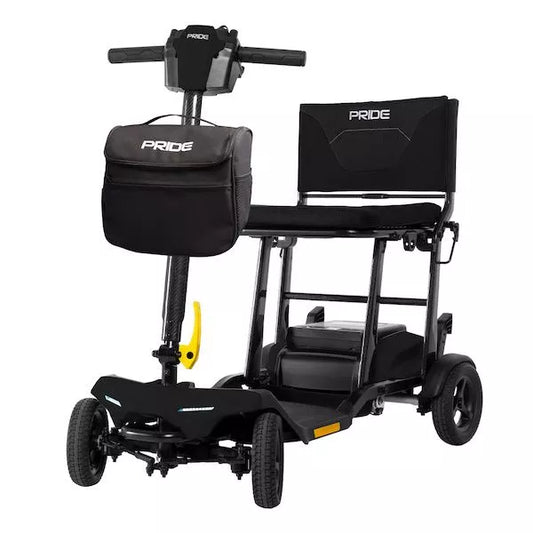
A Practical Guide to Mobility Scooter Parts and Repairs

Think of your mobility scooter as more than just a machine; it's your key to freedom and independence. And just like any reliable vehicle, knowing a little bit about what goes on under the hood can make all the difference in keeping it running perfectly for years to come. This guide will walk you through the essential mobility scooter parts, giving you the confidence to handle basic maintenance and troubleshooting.
Understanding Your Mobility Scooter's Key Parts
Your scooter is a lifeline, connecting you to friends, family, and the world around you. When something goes wrong, it’s not just an inconvenience—it can put your daily life on hold. That's why having a basic understanding of its core components is so empowering. It helps you pinpoint small problems before they become big ones, order the right part the first time, and get back to your life with minimal downtime.
The demand for this knowledge is growing right alongside the scooter market itself. The global market for mobility scooters hit an incredible USD 1.59 billion in 2025 and is expected to climb to USD 3.43 billion by 2034. With North America making up 44% of that market, it’s clear that more people than ever are relying on these devices. What this means for you is that knowing how to find quality replacement parts is an essential skill.
Why The Right Part Matters
Choosing the correct parts for your scooter isn't just a suggestion—it's critical. I've seen it happen too many times: someone orders a battery that looks right, only to find it's a millimeter too tall for the compartment. Or they get a controller that isn't compatible with their motor, leaving them stranded. The wrong tire can compromise stability, and an ill-fitting part can even cause further damage.
A $600 scooter that becomes unusable after a year is no bargain. A quality scooter that can be serviced and kept running for five or six years with the right parts is the true value.
This is exactly why sticking with reputable manufacturers and suppliers is your best bet. Instead of guessing with off-brand components, you get parts designed specifically for your model. For example, you can find a complete inventory of authentic parts withTop Mobility Parts Finder, which assist you in finding a perfect fit for that part replacement. While our focus is on scooters, it's interesting to note that many electric vehicles share similar principles; you can see this in guides to golf cart parts, where concepts like batteries and motors overlap.
To get started, we'll break down the scooter into its main systems, so you can see how everything works together to give you a safe, smooth ride.
- The Power System: This is the heart of your scooter—the batteries and chargers that provide the energy.
- The Drivetrain: Think of this as the muscle, including the motor, controller, and brakes that get you moving and stop you safely.
- The Foundation: These are the parts that provide structure and a smooth ride, like the tires, wheels, and frame.
2. The Power System: Batteries and Chargers
If your mobility scooter is the key to your freedom, think of the battery as its heart and the charger as its lifeline. Getting a handle on these two components is the best way to make sure you’re never left stranded. A happy power system means you get reliable performance, a predictable travel range, and the peace of mind to go about your day without worrying about your ride.
This quick visual shows just how central the power system is to your scooter's operation.

As you can see, everything starts with the battery. From steering with the tiller to the tires gripping the pavement, nothing happens without that power source. That’s why keeping your battery in top shape isn’t just a suggestion—it’s essential for a scooter you can depend on.
Comparing Battery Types
Scooter batteries generally fall into three main categories. Each has its own strengths, so picking the right one really depends on how you use your scooter.
- AGM (Absorbent Glass Mat): These are the trusted workhorses of the scooter world. They’re sealed, so you never have to worry about spills. For the price, they offer fantastic performance and a solid lifespan, making them a great all-around choice for daily use.
- Gel: Inside a Gel battery, the electrolyte is held in a thick, silica-based gel. This makes them incredibly tough and resistant to vibrations and deep discharges. If you’re a heavy-duty user or frequently travel over rougher ground, a Gel battery is built to take the punishment.
- Lithium-ion: As the newest technology on the block, lithium batteries pack a lot of power into a much lighter package and last significantly longer. They're a perfect match for travel scooters where every pound counts, though they do have a higher upfront cost.
Understanding Voltage and Amp-Hours
When you’re looking at batteries, you’ll run into two key numbers: Voltage (V) and Amp-Hours (Ah). Here’s a simple way to think about it: Voltage is the engine's power, and Amp-Hours is the size of the gas tank.
Your scooter is built to run on a specific voltage, typically 12V or 24V, and you absolutely must match this. The Ah rating, on the other hand, tells you how far you can go on a single charge. A bigger Ah number means a longer range.
It's a good thing to know, since batteries are the part you'll likely replace most often. In fact, we see batteries fail in about 40% of scooters within 18 to 24 months. The good news is that getting replacements has become much easier. The rise of online suppliers like Top Mobility has cut the typical downtime for repairs by over 50%, helping people get back to their lives much faster.
Recognizing When to Replace Your Power System
So, how can you tell it's time for a new battery or charger? Your scooter will usually give you some clear warning signs.
Signs of a Failing Battery:
- You can't travel nearly as far on a full charge as you used to.
- The battery seems to take forever to fully charge.
- Your scooter feels sluggish or struggles on hills it used to climb easily.
- You notice the battery case is bulging, cracked, or leaking fluid.
Signs of a Faulty Charger:
- The indicator lights on the charger don't light up or are acting strangely.
- The charger gets uncomfortably hot when it's plugged in.
- You hear a distinct buzzing or humming sound coming from the charger.
A common pitfall is immediately blaming the battery when a scooter won't turn on. A bad charger can't fill up even a brand-new battery, so it's always smart to check both before buying a replacement. For a deep dive into this, check out our guide on scooter battery replacement.
To find the right parts, the best place to start is the label on your current equipment. You'll need to match the voltage and physical size exactly. If you have a full-size model, a common and reliable option is the Interstate Batteries 12V 35Ah AGM Battery. For chargers, make sure the output voltage and connector plug are a perfect match for your scooter, like with a versatile model such as the Challenger Mobility 24V 5A Off-Board Charger.
The Drivetrain: Motors, Controllers, and Brakes
So, you've got fully charged batteries ready to go. But how does that electrical juice actually get your scooter moving down the path? That's the job of the drivetrain—a group of components working in perfect sync to turn stored energy into controlled motion.
Think of it as your scooter's muscle and brain. This system includes the motor, transaxle, controller, and brakes. The motor and transaxle assembly is the workhorse that physically turns the wheels. The controller is the "brain," taking your commands from the tiller and telling the motor precisely what to do. And of course, the electromagnetic brakes are the crucial safety system that brings you to a smooth, reliable stop.
Listening to Your Scooter: Diagnosing Drivetrain Issues
Over the years, I've found that the best diagnostic tool is often a good set of ears. Your scooter will almost always give you a heads-up before a major failure, and learning to interpret its sounds and behaviors can save you a lot of trouble.
Different noises usually point to different problems. If you know what to listen for, you can catch an issue early.
- Grinding or Whining Noise: If you hear a grinding or an unusually loud, whining hum that gets worse as you speed up, your focus should be on the motor or transaxle. This often signals that the internal bearings or gears are starting to wear out.
- Jerky or Stuttering Movement: Does your scooter lurch forward or move erratically instead of accelerating smoothly? This is a classic symptom of a failing controller. It's struggling to send a clean, steady signal to the motor.
- Clicking Without Moving: You press the throttle, hear a distinct "click," but the scooter stays put. The first thing to check is that you haven't accidentally engaged the freewheel lever. If that's not it, the problem is often the electromagnetic brake failing to disengage or, in some cases, another sign of a faulty controller.
One of the most common misdiagnoses I see is confusing a controller problem for a battery problem. If your battery gauge shows a full charge but the scooter is acting erratically or cutting out, the controller is the more likely culprit. When the "brain" malfunctions, the scooter's movements become completely unpredictable.
Sourcing the Right Replacement Drivetrain Parts
When it's time to replace a core drivetrain component, getting the exact right part is everything. These aren't like universal accessories; parts like motors and controllers are engineered specifically for your scooter's make, model, and sometimes even its year of manufacture.
The most important piece of information you'll need is your scooter's serial number. This is the key that unlocks the exact parts list for your specific machine. Before you order anything, find that number on your scooter's frame.
For example, a motor is typically sold as a complete motor and transaxle assembly. This is done for a reason—it ensures the motor, gearbox, and all internal components are perfectly matched for optimal performance and longevity. A perfect example is this Motor and Transaxle for the Pride Mobility Victory 10; it's built for a direct, factory-spec fit. You simply can't grab a generic motor off the shelf and expect it to work.
Likewise, controllers are programmed with software tailored to a specific scooter. They dictate everything from the acceleration curve to the diagnostic codes on your dashboard. Upgrading or replacing a joystick, for instance, requires a precise match. If uncertain with what part you need or issue you are experiencing, Speak with our parts expert and ensure you are getting the exact part needed. Always match the part number from your old controller to guarantee the new one will work correctly.
The Foundation: Tires, Wheels, and Frame Parts
Think of your scooter’s power system as its heart and lungs, but the tires, wheels, and frame? That’s the skeleton and feet. This is the foundation that provides a stable, comfortable, and reliable ride, and it all starts from the ground up. These parts dictate everything from how smoothly you glide over bumpy sidewalks to your overall safety and balance.

It’s no surprise that the market for mobility parts is booming, projected to hit USD 3.66 billion by 2034. With many people using their scooters for 5-10 miles every day, those foundational parts take a real beating. Tires, in particular, can wear out in as little as 6-12 months, which shows just how vital quality replacements are. You can actually explore more on this market trend to see how demand is growing.
Choosing the Right Tires for Your Lifestyle
Your scooter's tires are its only connection to the ground, making them one of the most critical mobility scooter parts for both safety and performance. They generally fall into two main categories, and the right one for you depends entirely on where you plan to go.
To help you decide, let's break down the pros and cons of each type.
| Feature | Pneumatic (Air-Filled) Tires | Solid (Flat-Free) Tires |
|---|---|---|
| Best For | Outdoor use, uneven terrain | Indoor use, smooth surfaces |
| Comfort Level | High (air acts as a cushion) | Lower (less shock absorption) |
| Maintenance | Requires regular air pressure checks | Virtually maintenance-free |
| Puncture Risk | Susceptible to flats | Puncture-proof |
| Traction | Generally better, especially outdoors | Good on dry, flat surfaces |
Essentially, pneumatic tires are like the ones on your car or a bicycle. They are filled with air, which acts as a natural shock absorber. This makes for a much smoother, more comfortable ride over cracks, grass, and bumpy paths. If you spend a lot of time outdoors, these are your best bet.
On the other hand, solid tires are exactly what they sound like—made of solid rubber or a dense foam. Their biggest advantage? They are completely puncture-proof. This makes them perfect for indoor settings like shopping malls, grocery stores, or just navigating your home, where you want total peace of mind and no chance of a flat.
The choice really comes down to a simple trade-off: superior comfort with pneumatic tires versus unbeatable reliability with solid ones.
How to Diagnose Tire and Frame Issues
Just like with a car, a quick inspection before you head out can save you a lot of trouble later. Catching problems early is the key to staying safe and avoiding more expensive repairs.
What to Look For:
- Worn-Out Tread: Take a look at the grooves on your tires. If they’re looking shallow or the surface is bald, it’s time for a new set. Worn tires lose their grip, which is especially dangerous on wet pavement.
- Cracks and Bulges: Give the sidewalls of your tires a good look. Any visible cracks, splits, or bulges are red flags. This often indicates dry rot or internal damage, meaning a blowout could be imminent.
- A Wobbly Tiller: Grab the steering column (the tiller) and give it a gentle wiggle side-to-side. If you feel a lot of play or wobbling, you might have a loose tiller bolt or a worn-out bushing that needs attention.
- Cracked Body Panels: Check the plastic panels, or shrouds, that cover your scooter's frame. A small crack might seem like just a cosmetic issue, but it can let moisture and dirt get to the sensitive electronics underneath.
A tip I always share: Don't neglect the air pressure in your pneumatic tires. I see it all the time—underinflated tires not only make your scooter harder to steer but also force the motor to work harder, which drains your battery much faster. Always keep them inflated to the PSI listed right on the tire’s sidewall.
Finding the Right Replacement Parts
When you do need a new tire or frame part, getting the exact right one is non-negotiable. For tires, the size is printed directly on the sidewall in a series of numbers, like "200x50" or "9x3.50-4". You must match these numbers perfectly to ensure a proper and safe fit.
For instance, a compact travel scooter designed for tight indoor spaces will likely have smaller, solid tires. In contrast, a heavy-duty bariatric model needs larger, often pneumatic, tires to handle more weight and navigate rougher outdoor ground.
You can explore a huge selection of scooter tires and wheels with Top Mobility's Part Finder, to get a sense of all the different sizes and tread patterns available. Whether you're after a simple flat-free tire or a complete wheel assembly with a new rim, matching the specifications to your scooter's model is the secret to a successful and easy repair.
Finding the Perfect Part with Our Parts Finder
When it comes to fixing your mobility scooter, getting the right part is everything. Ordering the wrong component can be incredibly frustrating—you waste time, money, and you're stuck dealing with returns while your scooter remains out of commission. Our whole goal is to help you get it right the first time, so you can order with total confidence.
The secret to a perfect match is your scooter's serial number. Think of it as your scooter's unique DNA. That single number tells us the exact make, model, and even the manufacturing run of your unit. With it, we can pinpoint the precise parts guaranteed to fit your machine.
How the Parts Finder Tool Works
We built the Top Mobility Parts Finder to take all the guesswork out of the equation. It's a straightforward tool that acts as a direct link between your scooter and our massive inventory of parts. You don't have to be a master mechanic—you just need that serial number.
When you open the tool, you'll see a few simple drop-down menus.
As you can see, you'll select the manufacturer and model. But the most important information is your serial number. Using it is the single most reliable way to ensure you're looking at a list of parts that are a 100% guaranteed fit.
OEM vs. Aftermarket Parts: What’s the Difference?
As you browse, you'll likely see two kinds of parts available: OEM and aftermarket. Knowing which one to choose is key to a successful repair.
- OEM (Original Equipment Manufacturer) Parts: These are the real deal, made by the same company that built your scooter (like Pride Mobility or Golden Technologies). They are identical to the part you're replacing and promise perfect compatibility, quality, and performance. For crucial components like motors, controllers, or chargers, we always recommend sticking with OEM.
- Aftermarket Parts: These are made by other companies, not the original manufacturer. While they're often cheaper, the fit and quality can be a roll of the dice. They might be a decent choice for simple, universal items like standard tires or accessories, but they carry a real risk when used for complex electronic or mechanical systems.
Choosing an OEM part is an investment in your scooter's reliability and safety. It might cost a little more upfront, but it ensures your scooter runs exactly the way it was designed to, protecting its performance and longevity for years to come.
Still Not Sure? Our Experts Are Here to Help
Even with the best tools, sometimes you just want a second opinion. That’s where our lifetime customer support comes in. Before you click that "buy" button, give our team a call. We can take your serial number and personally verify that you've chosen the correct part.
This little double-check provides an extra layer of confidence and has saved countless customers from the headache of getting an incompatible part.
For instance, the design of a Pride Mobility Victory Full Size Mobility Scooter can change slightly from one model to the next and one years model to the next. Our experts can confirm you’re getting the right part. Need a new set of motor brushes? We’ll make sure you get the exact size your motor requires.
We’re here to help you get the job done right on the first try.
Enhancing Comfort and Utility with Accessories

While the core mobility scooter parts like the battery and motor are the engine of your freedom, accessories are what truly make your scooter yours. They’re the difference between having a machine that simply gets you from A to B and having a ride that’s perfectly customized for your lifestyle.
Think of your scooter as a great, reliable car. The accessories are the creature comforts and practical add-ons—the premium sound system, the cargo organizer, the comfortable seats—that make every trip a pleasure. From a simple basket for groceries to an ergonomic seat for all-day excursions, these upgrades can completely change your daily experience.
Upgrades for All-Day Comfort
Let's be honest, long rides shouldn't feel like an endurance test. If you find yourself getting stiff or sore after a while, your standard seat might be the culprit. Fortunately, swapping it out or adding a cushion is one of the easiest and most impactful upgrades you can make.
For those with full-size scooters, upgrading to a captain's seat is often a game-changer. These seats are built for support, with higher backrests, headrests, and contoured padding that helps your posture.
You don't always need to replace the whole seat to feel a major improvement. A high-quality pressure relief cushion is designed to distribute your weight evenly, which helps prevent soreness and keeps your circulation flowing on those extended trips.
Essential Accessories for Safety and Storage
Beyond comfort, some of the most practical accessories are all about boosting your safety and carrying capacity. Being seen by others is non-negotiable, especially around traffic or in crowded areas. And having a way to carry your things without juggling bags just makes life easier.
Top Accessories for Utility:
- High-Visibility Flags: It might seem simple, but a bright orange or red safety flag is incredibly effective. It makes you stand out from a distance, giving drivers and pedestrians plenty of time to see you.
- Mirrors: Just like in a car, a good pair of mirrors gives you a clear view of what’s behind and beside you. This is a huge help when backing up or navigating busy sidewalks without having to twist uncomfortably.
- Weather Protection: If you have to park your scooter outside, an all-weather cover is your best friend. It shields the electronics, seat, and controls from rain, sun, and dust. A cover like the Challenger Universal Cover is designed to fit most models and protect your investment.
Your Mobility Scooter Parts Questions Answered
When you're trying to get your mobility scooter back on the road, knowing where to start can feel overwhelming. Having the right information is just as important as having the right tools. Let's walk through some of the most common questions we hear from scooter owners—a few clear answers can make all the difference.
How Do I Find the Serial Number on My Scooter?
Think of the serial number as your scooter's unique ID. It’s the single most important piece of information for getting parts that fit perfectly. This number is almost always on a small white or silver sticker attached somewhere on the scooter's main frame.
The usual hiding spots are on the frame itself (often under the rear plastic body panels), on the seat post, or tucked away under the floor mat. If you have a Pride Mobility scooter, a good first place to check is the frame right near the batteries. Once you have that number, plugging it into our Parts Finder will guarantee you see the right components.
Can I Use a Battery with a Higher Amp Hour Rating?
Absolutely. In most cases, upgrading to a battery with a higher Amp Hour (Ah) rating is a fantastic way to get more range out of your scooter.
The most important thing is to match the voltage (12V is standard) and make sure the new battery physically fits in the battery box. For example, you could easily swap a Interstate Batteries 12V 35Ah AGM Battery for a 50Ah one and see a huge boost in how far you can travel. Just be sure to compare the length, width, and height specs on the product page before you buy.
What Is the Difference Between OEM and Aftermarket Parts?
OEM stands for Original Equipment Manufacturer. These are parts made by the very same company that built your scooter, like Pride Mobility or Golden Technologies. They are designed to be a perfect match, guaranteeing flawless fit and function.
Aftermarket parts, on the other hand, are made by third-party companies. While they might be easier on the wallet, the quality and fit can be a bit of a gamble. For critical components that affect safety and performance—like motors, brakes, and controllers—we always recommend sticking with OEM parts. It’s the best way to ensure your scooter remains reliable and safe.
A clicking sound without any movement is a very common issue with a few possible causes. Diagnosing it step-by-step can help you find the source without replacing unnecessary parts.
My Scooter Clicks but Won't Move. What Is Wrong?
That single click is a classic symptom, and the first thing you should check is the freewheel lever. This lever, usually located at the back of the scooter near the wheels, is designed to disengage the motor so you can push the scooter manually. If it’s in the "freewheel" position, the motor won't engage.
If the lever is in the right spot, the problem could be an electromagnetic brake that’s stuck and failing to release. It could also point to a faulty controller. Before you go too far, also give your battery terminals a quick check to make sure they're clean and tight. For more ideas on what to look for, a general vehicle inspection checklist can offer some great tips for routine maintenance.
At Top Mobility, our experts are always here to help you pinpoint the exact part you need. Explore our full range of certified mobility scooter parts and order with confidence today.